
What does Illinois fence law say about division fences?
The Illinois Fence Act, 765 ILCS 130, is the state law on fences between adjoining landowners. Each owner makes and maintains a just proportion of the division fence. A legal fence is four and one-half feet high and in good repair.
Disputes over each owner’s share go to fence viewers. A neighbor who will not build or repair their share can be given written notice. The hedge fence rule sets a trim schedule for hedges on the line.
This is general information, not legal advice. For a dispute on your line, call your township or county fence viewers, or talk with an attorney. In town, fence height is set by local ordinance and any HOA rules, so check with your city or village.
Who pays for a division fence in Illinois?
Both owners do. Section 3 covers two or more people with adjoining land. Each one makes and maintains a just proportion of the division fence.
Section 4 adds a rule for land outside city or village limits, in counties under 1,000,000 people. When one owner wants to enclose their land, each adjoining owner builds or pays for a just proportion. Upkeep is shared in the same proportion. If you cannot agree on the split, the fence viewers settle it.
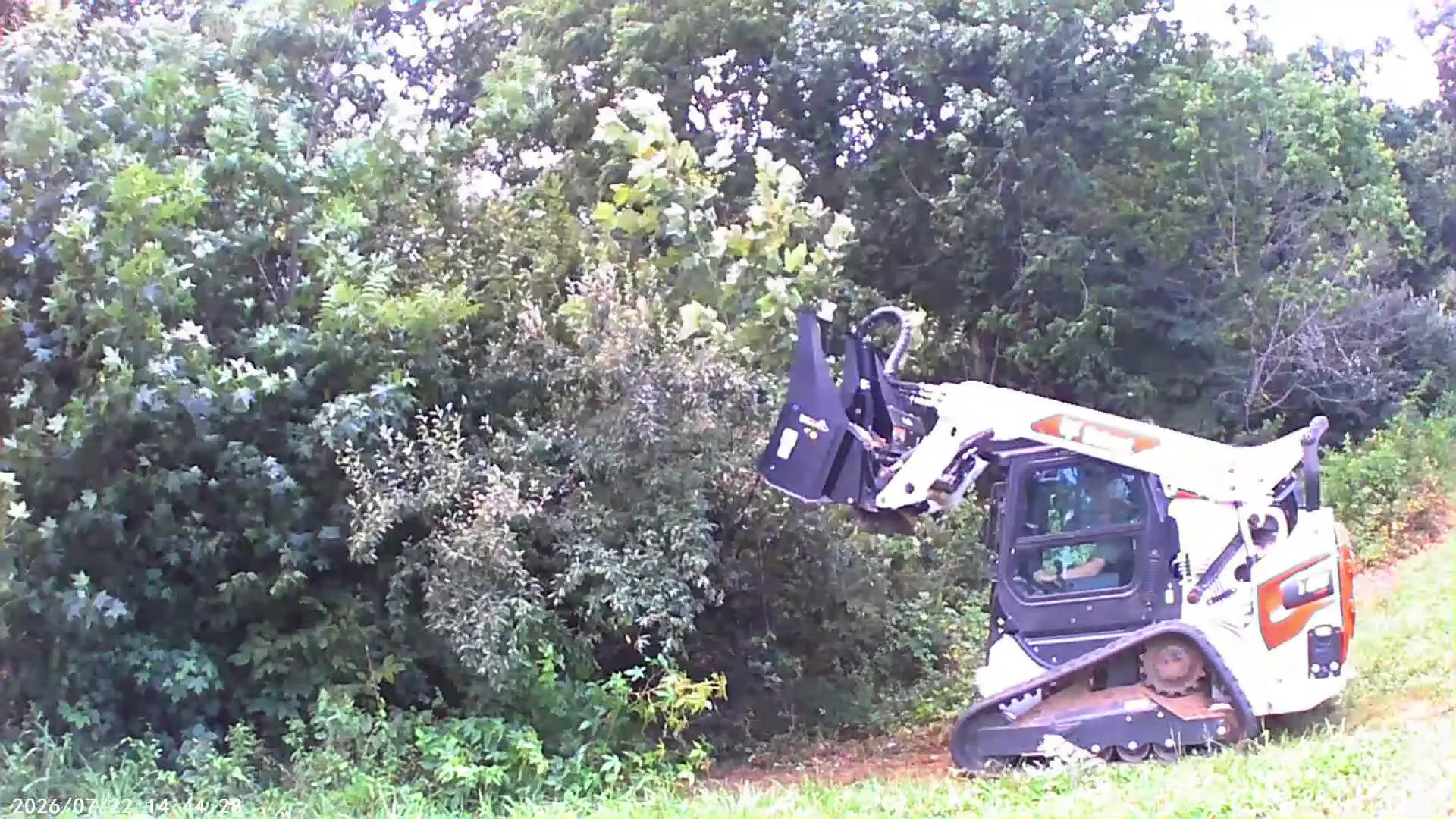
Your share has to stay in good repair, and nobody can repair wire they cannot reach. When a fence row has grown shut, fence line clearing opens it back up. We grind the brush, vines and saplings where they stand and cut the stems to grade level. That gives you or a fence builder room to check and fix the fence.
What counts as a legal fence in Illinois?
Section 2 sets the standard. A legal fence is four and one-half feet high and in good repair. The listed materials include rails, stone, hedges, barb wire and woven wire. Anything the fence viewers consider equivalent also counts.
Whatever it is made of, the fence has to be enough to keep livestock off the adjoining land. At the annual town meeting, township voters may decide what counts as a legal fence in their township. In a county without townships, the county board regulates fence height. Check with your township or county before you build to the state number.
Hedges are on that list, and Section 3 gives them their own trim schedule. Keeping any fence in good repair starts with being able to see it.
Who are the fence viewers in Illinois?
Fence viewers are local officials who settle fence disputes under the Act. In a county under township organization, the township board of trustees serves as the fence viewers. In a county without townships, the presiding officer of the county board appoints three fence viewers in each precinct, with the board’s consent.
Williamson County, for one, discontinued township government in 1932. The county’s website says it is one of 17 Illinois counties that operate under the commission form of government. Under Section 1, that puts the fence viewer appointments with the county board’s presiding officer.
Not sure how your county is set up? Your county clerk’s office can tell you.
How does a fence dispute get settled in Illinois?
Section 7 says any two fence viewers can settle a dispute over each owner’s share. They mark each owner’s portion of the fence. Under Sections 8 and 9, each side picks one fence viewer. If those two disagree, they pick a third, and a decision by any two of them is final.
Section 10.1 covers a case that stalls. If the fence viewers do not decide within 90 days, the county board or township board may take it up. After 60 more days, either side may petition the circuit court. If your dispute is headed that way, talk with an attorney.
How much notice does the Illinois Fence Act require?
Section 11 covers a neighbor who will not build or repair their share. You can give 60 days written notice to build it, or 10 days written notice to repair it. After that, you may do the work and recover the cost in circuit court.
Section 14 covers taking a fence out. Say you want to remove your division fence and let the land go uncultivated and unpastured. You give the adjoining owner one year’s written notice, and you need that owner’s permission.
Put every notice in writing and keep a dated copy. When a fence is going to be rebuilt, the row has to be open first. We clear an overgrown fence row at ground level so the builder has room to work.
What is the hedge fence rule in the Illinois Fence Act?
Section 3 sets a trim schedule for a hedge used as a division fence. The year after the hedge turns 7 years old, its owner cuts it back to no more than 4 feet. After that, it gets cut back to 5 feet at least once every 2 years. The trim is due on or before June 15 of the year it should be done.
Say the hedge owner skips it. A neighbor who has met the rule on their own part of the fence can give 10 days written notice. If it is ignored, the neighbor may cut or trim the hedge and recover the cost and damage in court.
The rule does not apply to a hedge protecting an orchard, buildings or a windbreak. It also leaves out a hedge kept to preserve wildlife and protect against soil erosion. Those exempt hedge fences may not exceed 60 rods in length.
A hedge that goes years without a trim grows into a row of trees. Cutting an old hedgerow back to 4 or 5 feet is tree work for a tree service. Our work is at ground level. We clear the brush, vines and saplings out of fence rows and hedgerows with a forestry mulcher.
The chips stay on the ground as mulch. Brush that has spread out into the field is brush clearing work, and the same machine handles it.
What does the Illinois Fence Act say in each situation?
Here is the Act at a glance. Section numbers refer to 765 ILCS 130.
| Situation | What the Fence Act says | Section |
|---|---|---|
| You and a neighbor own adjoining land | Each owner makes and maintains a just proportion of the division fence | 3 |
| One owner wants to enclose their land | Outside city or village limits in counties under 1,000,000 people, each adjoining owner builds or pays for a just proportion and shares upkeep the same way | 4 |
| What counts as a legal fence | Four and one-half feet high and in good repair, enough to keep livestock off the adjoining land. Township voters may set a local standard at the annual town meeting. Where there are no townships, the county board regulates fence height | 2 |
| Who the fence viewers are | The township board of trustees in a township county. Three per precinct in a county without townships, appointed by the county board’s presiding officer with the board’s consent | 1 |
| You cannot agree on the shares | Any two fence viewers settle it and mark each owner’s portion. Each side picks one, and a decision of any two is final | 7 to 9 |
| The fence viewers have not decided in 90 days | The county board or township board may take it up. After 60 more days, either side may petition the circuit court | 10.1 |
| A neighbor will not build or repair their share | 60 days written notice to build or 10 days written notice to repair, then you may do the work and recover the cost in circuit court | 11 |
| A hedge fence on the line | Cut to no more than 4 feet the year after it turns 7, then to 5 feet at least once every 2 years, on or before June 15 | 3 |
| The hedge owner skips the trim | A neighbor who met the rule on their own part may give 10 days written notice, then cut or trim it and recover the cost and damage | 3 |
| A hedge protects an orchard, buildings or a windbreak | The trim rule does not apply. Hedges kept to preserve wildlife and protect against soil erosion are exempt too. Exempt hedge fences may not exceed 60 rods in length | 3 |
| You want to remove your division fence | One year’s written notice to the adjoining owner, and that owner’s permission | 14 |
Need a fence row cleared before the fence work starts?
Call or text (618) 697-5190 for a free estimate. Small jobs are welcome. Tell us where the line runs and what the fence needs next.
Blackburn Land Service is based in Cobden. We work across Jackson, Union and Williamson counties, plus nearby parts of Johnson and Saline counties.